



 Product Inquiry:137-7170-5679
Main Features
· High Efficiency & High Sulfur Capacity: Reacts rapidly and thoroughly with sulfur compounds. The desulfurizer features a high total sulfur removal capacity per unit weight or volume, ensuring a long service life.
· High Selectivity: Reacts preferentially or exclusively with sulfur compounds such as H₂S, with minimal adsorption of valuable gas components (e.g., H₂, CO, CH₄), guaranteeing high recovery of the main gas.
· Irreversible Reaction: Most reactions proceed via chemical absorption to form stable metal sulfides, resulting in thorough desulfurization with no risk of sulfur desorption.
· Good Mechanical Strength: Excellent resistance to crushing and abrasion, capable of withstanding bed pressure and long-term gas scouring without pulverization or clogging.
· Versatile Forms & Adaptability: Available in normal-temperature, medium-temperature and high-temperature grades, as well as iron oxide-based, zinc oxide-based, activated carbon-based and molecular sieve-based types to suit various temperature, pressure and feed gas conditions.
■ Technical Indicators
| Indicator Name | Unit | Representative Meaning & Typical Requirements |
| Working Sulfur Capacity | % or kg-S/kg(orm³) |
A core performance indicator referring to the sulfur load that the desulfurizer can bear before breakthrough. Both breakthrough sulfur capacity (when outlet sulfur content reaches the limit) and saturation sulfur capacity (complete failure) are important. High-quality desulfurizers usually have a sulfur capacity of > 20% by weight. |
| Desulfurization Precision | ppm or mg/m³ | The residual total sulfur content or H₂S concentration in the treated gas reflects deep purification capability. High-precision desulfurizers can reduce outlet H₂S to < 0.1 ppm, meeting stringent requirements for chemical synthesis and other applications. |
| Side Crushing Strength | N/cm or MPa | Measures the particle crushing resistance to ensure stable bed structure. Industrial formed desulfurizers typically require > 50 N/cm. |
| Bulk Density | kg/L or g/mL | Mass per unit volume, which affects reactor design and filling volume. Depending on the material, it usually ranges from 0.7 to 1.4 kg/L. |
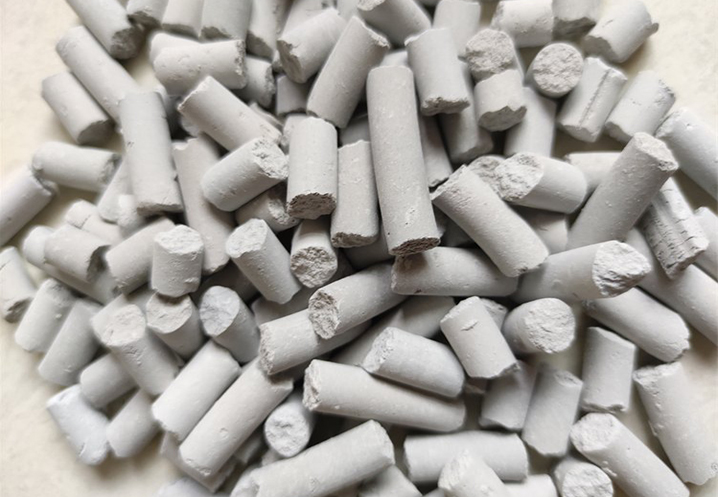
| Particle Size / Shape | mm or mesh | Affects gas flow resistance (pressure drop) and reaction contact area. Common forms are cylindrical strips (e.g., Φ4–6 mm) or spherical particles with uniform size. |
| Applicable Temperature / Pressure | ℃ / MPa | The effective operating temperature and pressure range of the desulfurizer. Normal-temperature type (20–60℃), medium and high-temperature type (200–400℃). |
| Main Chemical Components | - | Specifies active components (such as Fe₂O₃, ZnO) and their contents, as well as information on carriers, binders and accelerators. |