



 Product Inquiry:137-7170-5679
Hydrogen Production Technology from Ammonia Cracking
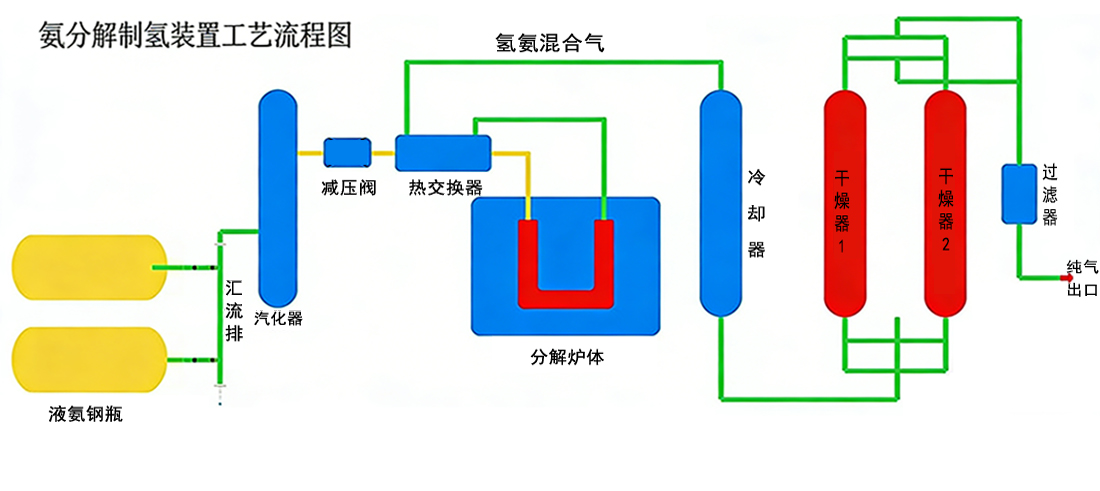
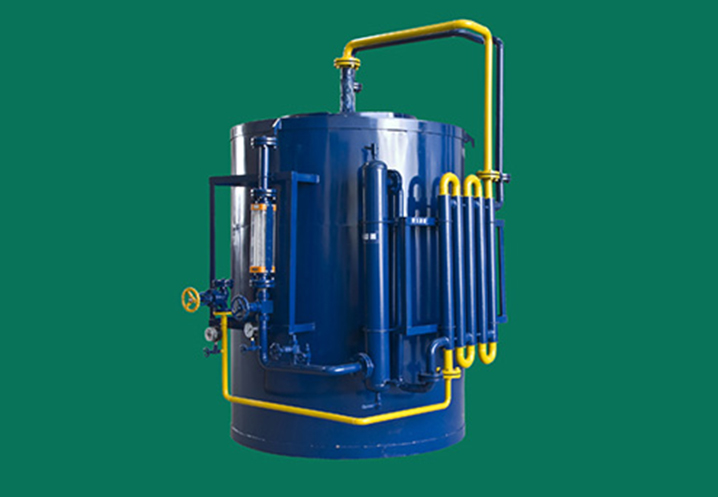
Gaseous ammonia from ammonia cylinders or tanks is depressurized through an ammonia pressure reducing valve. The reduced-pressure ammonia gas passes through a heat exchanger to exchange heat with cracked gas, and then is sent into the cracking furnace (filled with activated nickel catalyst inside). Ammonia is cracked into hydrogen-nitrogen mixed gas at 800℃. The high-temperature hydrogen-nitrogen mixed gas enters the heat exchanger again to exchange heat with gaseous ammonia, cooling down the cracked gas while recovering heat to heat up the gaseous ammonia. After heat exchange, the cracked gas is further cooled in a cooler before being sent to the point of use.
■ Technical Features
· Compact structure, small footprint, low investment cost, convenient later maintenance with controllable expenses;· High degree of automation, easy to operate, uniform air distribution, and lower operation energy consumption;
· Adopts sleeve-type heat exchanger with sufficient heat exchange area, high thermal efficiency and long service life.
■ Reaction Principle
2NH3————3H2+N2■ Main Performance Indicators
· Gas output flow rate: 5~3000Nm3/h· Residual ammonia content: ≤500ppm
· Oxygen content: ≤3ppm
· Dew point temperature:≤-10℃
■ Process Flow Diagram